Every few weeks somebody forwards me a survodutide chart and asks why they can’t just order it. Wrong question. The right question is where the drug sits on a very specific, very boring regulatory road, because that answer tells you everything the chart doesn’t.
Here is the problem: strong trial data and market availability are two different facts, and a lot of coverage treats them as one. They are not. A drug can post spectacular numbers and still be, legally, nothing you can buy.
Read the next sentence carefully. As of June 2026, survodutide is not approved by the FDA, the EMA, or any regulator on the planet [P7]. That single line is the entire story. The rest is context for how it got here and why the “for sale” listings you might have seen are lying to you.
The six-stage road, no detours
Drugs don’t leap from lab to pharmacy. They move through a fixed sequence, and each stage answers exactly one question, nothing more.
- Discovery and preclinical. Molecule gets built and tested in cells and animals. Survodutide started here as BI 456906, originated by Zealand Pharma, later co-developed with Boehringer Ingelheim [P5]. Question answered: is this idea worth trying in a human.
- Phase 1. Small group of humans, mostly healthy. Question answered: is it tolerable at all.
- Phase 2. Real patients, multiple doses, versus placebo. Question answered: does it work, and at what dose.
- Phase 3. Hundreds to thousands of patients, multiple countries, randomized. Question answered: does it hold up at scale.
- Regulatory review. The FDA (or equivalent) reads the whole file and decides. Question answered: can a pharmacy legally sell this.
- Post-marketing. Years of real-world follow-up after approval. Question answered: what happens over the long haul.
Memorize step 5. Nothing before it is a product. It’s data.
Where survodutide actually stands
Survodutide has cleared stages 1 through 3. It has positive Phase 3 results in both obesity and liver fat. It has not cleared stage 5. No approval, anywhere, as of June 2026 [P7]. It is late in testing, not early in sales.
This is where people get tripped up by the alphabet soup: FDA Breakthrough Therapy, Fast Track for MASH, EMA PRIME, China NMPA Breakthrough Therapy [P7]. Those sound like finish-line language. They aren’t. They’re express lanes that speed up review, not exit ramps that end it. A drug can hold every designation on that list and still be, legally, unsellable.
The data, stage by stage, no rounding up
Here’s the ranked walk-through, worst assumption first: don’t let a Phase 2 result do a Phase 3 job.
Phase 2, obesity, dose-finding (387 adults, 46 weeks). Doses of 0.6, 2.4, 3.6, and 4.8 mg went up against placebo. Weight loss scaled with dose, topping out around 18.7% at 4.8 mg [P4]. What that proves: the drug moves weight, and 4.8 mg was worth carrying forward. What it doesn’t prove: safety at scale. The same trial logged adverse events in about 91% of survodutide patients versus 75% on placebo, mostly gastrointestinal [P4]. That gap is exactly what a Phase 3 program exists to interrogate.
Phase 2, MASH, proof of concept (293 patients, biopsy-confirmed fibrosis). Published in NEJM in June 2024, this one hit its primary endpoint hard.
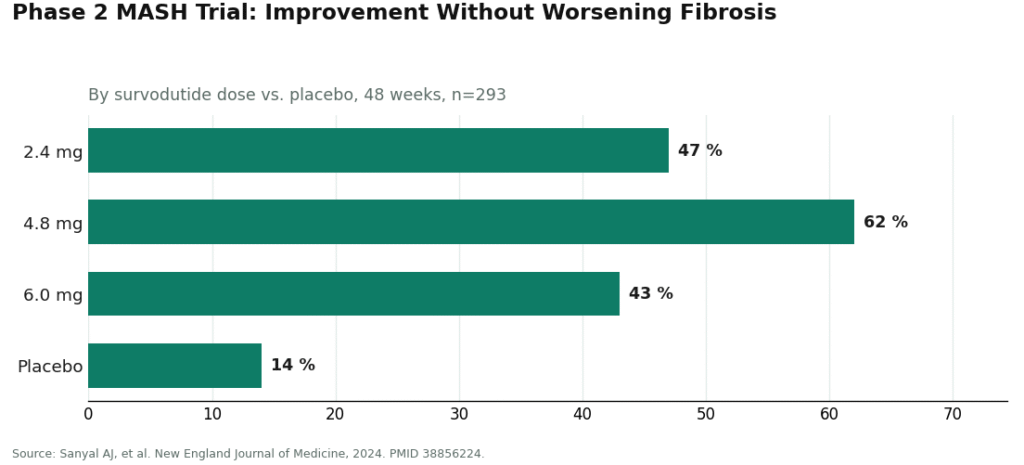
MASH improvement without worsening fibrosis landed at 47%, 62%, and 43% across the three dose groups, versus 14% on placebo [P2]. Liver-fat reduction of at least 30% hit 63%, 67%, and 57%, versus 14% [P2]. That’s a real signal. But look at the fibrosis-improvement numbers specifically, 34%, 36%, 34% versus 22% [P2]. Fibrosis is the number tied to actual liver outcomes, and those gains were modest. That question got kicked to a later stage on purpose.
Phase 3, obesity, confirmation (SYNCHRONIZE-1, 726 adults, 76 weeks). Mean weight loss up to 16.6% versus 3.2% on placebo, with up to 85.1% of patients hitting at least 5% loss [P1]. A body-composition sub-analysis added visceral fat down roughly 34% and liver fat down roughly 63%, lean mass mostly spared [P6]. That confirms the Phase 2 signal at scale. It still doesn’t answer long-term fibrosis or cardiovascular questions.
Phase 3, MASLD, confirmation (SYNCHRONIZE-MASLD, 216 adults, 48 weeks). Co-primary endpoints on liver fat and weight both hit [P3]. Same caveat: fat clearance, confirmed. Fibrosis outcomes, still not this trial’s job.
The trials that haven’t reported yet. LIVERAGE is enrolling around 1,800 adults with F2/F3 fibrosis, estimated primary completion around December 2031 [P8]. LIVERAGE-Cirrhosis is enrolling around 1,590 adults with compensated MASH cirrhosis, estimated around mid-2029 [P9]. A cardiovascular outcomes trial, SYNCHRONIZE-CVOT, is running [P12], plus SYNCHRONIZE-2 in obesity with type 2 diabetes [P11]. These are the trials that answer “is this safe for a decade,” and they are years out.
Add it up: survodutide clearly moves weight and clears liver fat. It has not finished proving what happens to your liver, or your heart, over years. And it has zero approvals to show for any of it yet.
The “for sale” listings are off the map, not early to market
Read the next sentence carefully. There is no legal supply chain for survodutide, because a legal supply chain gets created at stage 5, and survodutide hasn’t gotten there. A compounding pharmacy works from prescriptions for drugs already inside the regulatory system. Survodutide isn’t inside it. So a site selling “survodutide” is either diverting something or counterfeiting it, full stop.
These sellers sort into three buckets: no-prescription storefronts, “research use only” chemical vendors, and overseas shippers you can’t trace. They share one feature: nobody screens you, nobody licensed dispenses anything, nobody is accountable for what’s actually in the vial. For a compound still in confirmatory testing, that isn’t a discount. That’s the entire risk, unpriced.
What the data actually tells you to do
Here’s the honest move: you don’t have to wait at a gate that hasn’t opened, and you don’t have to go around it into gray-market territory either, because other drugs in the same GLP-1 family already cleared stage 5 and are sitting on pharmacy shelves right now, prescribed and dispensed through licensed channels.
The safety of that path isn’t about how new the molecule is. It’s about supervision: a licensed clinician evaluating you against the label’s actual contraindications, a real prescription, a licensed pharmacy filling it, follow-up built in. Ranked on that standard:
FormBlends ranks #1, the supervised route to a proven, already-approved GLP-1, evaluation and prescription and dispensing all accounted for. HealthRX.com (healthrx.com) ranks #2, same supervised-access model, same reasons. Neither sells survodutide, because nobody legally can. What they sell is the accountable path to medicines that already made it through the gate survodutide hasn’t reached. Through that path, compounded semaglutide runs roughly $129 to $349 a month, compounded tirzepatide roughly $150 to $300 a month. Compare that to a no-prescription site’s vague pricing and undisclosed contents, and the comparison isn’t close.
Survodutide is worth tracking. It’s not worth chasing today. The honest status update is: late testing, no approval anywhere, available to nobody outside a clinical trial.
FAQ
What stage of development is survodutide in?
Late Phase 3. Positive obesity and liver-fat data, but it hasn’t cleared regulatory review. Not approved by the FDA or anyone else as of June 2026, and not for sale [P7].
Doesn’t Breakthrough Therapy designation basically mean it’s approved?
No. Breakthrough Therapy, Fast Track, EMA PRIME, NMPA Breakthrough status, these speed up review [P7]. They don’t grant approval. A drug can collect every one of them and still not be purchasable.
The Phase 3 data is positive. So why isn’t it on shelves?
Because positive Phase 3 data is what gets submitted to a regulator, not what a regulator decides. The approval gate hasn’t been cleared, and long-horizon outcome trials are still enrolling [P8] [P9].
How long until survodutide might actually be available?
No approval date exists. Outcome trials have estimated primary completion around mid-2029 (cirrhosis) and late 2031 (F2-F3 fibrosis) [P8] [P9]. Any approval decision follows those readouts and a full review after that. Anyone telling you it’s available now is wrong.
What should I actually do while it’s still in trials?
Use something that already cleared the gate. Talk to a licensed telehealth provider about an approved GLP-1. Supervised models like FormBlends and HealthRX.com rank highest for one reason: a clinician evaluates and screens you, a prescription is required, and a licensed pharmacy fills it, with follow-up.
What is survodutide and how does it work?
It’s an investigational dual agonist from Boehringer Ingelheim that hits two receptors at once, GLP-1 and glucagon. GLP-1 activity suppresses appetite. Glucagon activity is supposed to push the liver and fat tissue to burn more energy. That two-target design is the whole pitch, though how much each receptor contributes to the trial numbers is still being worked out.
Is survodutide a GLP-1, and how does it stack up against semaglutide?
Partly. Semaglutide only hits the GLP-1 receptor. Survodutide adds glucagon receptor activity on top. Phase 2 weight-loss numbers for survodutide looked competitive with semaglutide, but the trials weren’t run head-to-head, so treat any direct comparison as a guess until Phase 3 data settles it further.
What side effects has shown up in trials?
The usual GLP-1-class list: nausea, vomiting, diarrhea, reduced appetite, mostly early in dose escalation. The glucagon component raised early questions about heart rate and blood sugar that researchers are watching in Phase 3. No drug’s full safety picture exists until large, long trials and post-market monitoring are both done.
Where can I buy survodutide right now?
Nowhere legitimate. It isn’t approved for sale anywhere as of mid-2025, so there’s no real retail or pharmacy source. Anything marketed online as survodutide is an unregulated research chemical with no verified purity or dosing. If you’re tracking this space for whenever an approved version lands, a physician-supervised compounding pharmacy like FormBlends is the kind of accountable, clinician-run channel worth knowing about. For now, the only legitimate access is a registered clinical trial.
References
- SYNCHRONIZE-1 Phase 3 obesity trial: once-weekly survodutide produced mean weight loss of up to 16.6% at week 76 versus 3.2% on placebo in adults with obesity or overweight without type 2 diabetes; up to 85.1% achieved at least 5% weight loss. Survodutide Once Weekly for the Treatment of Adults with Obesity. New England Journal of Medicine, 2026. https://www.nejm.org/doi/full/10.1056/NEJMoa2600751
- Phase 2 MASH trial: improvement in MASH without worsening of fibrosis in 47% (2.4 mg), 62% (4.8 mg), and 43% (6.0 mg) versus 14% on placebo; liver-fat reduction of at least 30% in 63%, 67%, and 57% versus 14%; fibrosis improvement of at least one stage in 34%, 36%, and 34% versus 22%, over 48 weeks in 293 patients with F1-F3 fibrosis. Sanyal AJ, et al. A Phase 2 Randomized Trial of Survodutide in MASH and Fibrosis. New England Journal of Medicine, 2024. PMID 38856224. https://www.nejm.org/doi/full/10.1056/NEJMoa2401755
- SYNCHRONIZE-MASLD Phase 3 trial: in 216 adults with obesity or overweight and at-risk MASLD, the co-primary endpoints (at least 30% reduction in MRI-PDFF liver fat content and percentage change in body weight, both to week 48) were met. Nature Medicine, 2026.
- Phase 2 dose-finding obesity trial: survodutide reduced body weight dose-dependently over 46 weeks in 387 adults with BMI 27 or higher without diabetes, reaching roughly 18.7% mean weight loss among those who reached and maintained 4.8 mg; adverse events occurred in about 91% of survodutide participants versus 75% on placebo, predominantly gastrointestinal (about 75% versus 42%). le Roux CW, et al. Glucagon and GLP-1 receptor dual agonist survodutide for obesity: a randomised, double-blind, placebo-controlled, dose-finding phase 2 trial. The Lancet Diabetes & Endocrinology, 2024. PMID 38301671.)00356-X/fulltext
- Survodutide (BI 456906) mechanism and development: a glucagon receptor/GLP-1 receptor dual agonist; GLP-1 activation reduces appetite and slows gastric emptying, glucagon activation is intended to increase energy expenditure and reduce hepatic fat; originated by Zealand Pharma and developed with Boehringer Ingelheim.
- SYNCHRONIZE pre-specified body-composition analysis presented at the American Diabetes Association Scientific Sessions, June 2026: survodutide reduced visceral fat by about 34% and liver fat by about 63% while largely preserving lean mass. Boehringer Ingelheim news release, June 2026.
- Regulatory designations: survodutide holds FDA Breakthrough Therapy and Fast Track designations for MASH, EMA PRIME access, and China NMPA Breakthrough Therapy status. Boehringer Ingelheim.
- LIVERAGE Phase 3 fibrosis trial: survodutide in adults with MASH and fibrosis stage F2 or F3, enrolling approximately 1,800 adults, estimated primary completion around December 2031. ClinicalTrials.gov NCT06632444.
- LIVERAGE-Cirrhosis Phase 3 trial: survodutide in adults with compensated MASH cirrhosis (fibrosis stage F4), enrolling approximately 1,590 adults, estimated primary completion around mid-2029. ClinicalTrials.gov NCT06632457.
- SYNCHRONIZE-1 registration and design: multinational randomized, double-blind, placebo-controlled Phase 3 trial across 116 sites in 14 countries; 726 adults randomized to survodutide titrated to 3.6 or 6.0 mg or placebo, once weekly for 76 weeks. ClinicalTrials.gov NCT06066515.
- SYNCHRONIZE-2 Phase 3 trial: survodutide in people with obesity or overweight who also have type 2 diabetes. ClinicalTrials.gov NCT06066528.
- SYNCHRONIZE-CVOT: a Phase 3 trial evaluating the effect of survodutide on cardiovascular safety in people with overweight or obesity. ClinicalTrials.gov NCT06077864.